 简体中文
 English


Why is the sand dried unevenly by a single-drum dryer?
release time:
2026-11-09
In a quartz sand production line, the single-drum dryer handles the final dewatering task, and stable discharge moisture is the prerequisite for qualified finished products. However, many customers find that during dryer
In a quartz sand production line, the single-drum dryer handles the final dewatering task, and stable discharge moisture is a prerequisite for qualified finished product. However, many customers find that during dryer operation the discharge moisture fluctuates: some material in the same batch is thoroughly dried while some still carries dampness, with the moisture content jumping back and forth between 0.5% and 3%. Checking the hot air temperature and drum rotation speed seems to show everything normal; the problem often lies in more hidden systemic links.
Unstable feeding is the source of moisture fluctuation. The front-end feeding equipment lacks sufficient control precision, so the material flow entering the drum per unit time keeps deviating; with total heat supply unchanged, the effective heat allocated per unit mass of material changes accordingly, and discharge moisture naturally cannot stay stable. At the same time, if the initial moisture content of the incoming material differs markedly between batches, discharge moisture will fluctuate even if the dryer's operating conditions are completely stable. It is recommended to add a buffer silo before the dryer, paired with a variable-frequency feeder, to keep feed rate fluctuation within ±5%. Sample and test the feed moisture content every shift; when fluctuation exceeds 3 percentage points, adjust the upstream dewatering process in time.
Imbalance in the thermal system is the core cause of unstable moisture. When the burner's fuel supply or combustion state fluctuates, the hot air temperature entering the drum changes accordingly; the total evaporation heat obtained by the material keeps drifting, and moisture evaporation efficiency cannot stabilize. Air leakage in ducts or dust and slag buildup on heat exchange components likewise weakens effective heat transfer and intensifies oscillation of the thermal environment inside the drum. Check the burner flame color; a yellow or red flame indicates incomplete combustion, so clean the nozzle and adjust the air damper. Also check the seals at the drum's feed and discharge ends; when air leakage is high, a large amount of heat is lost and thermal efficiency drops from above 80% to the 60% range.
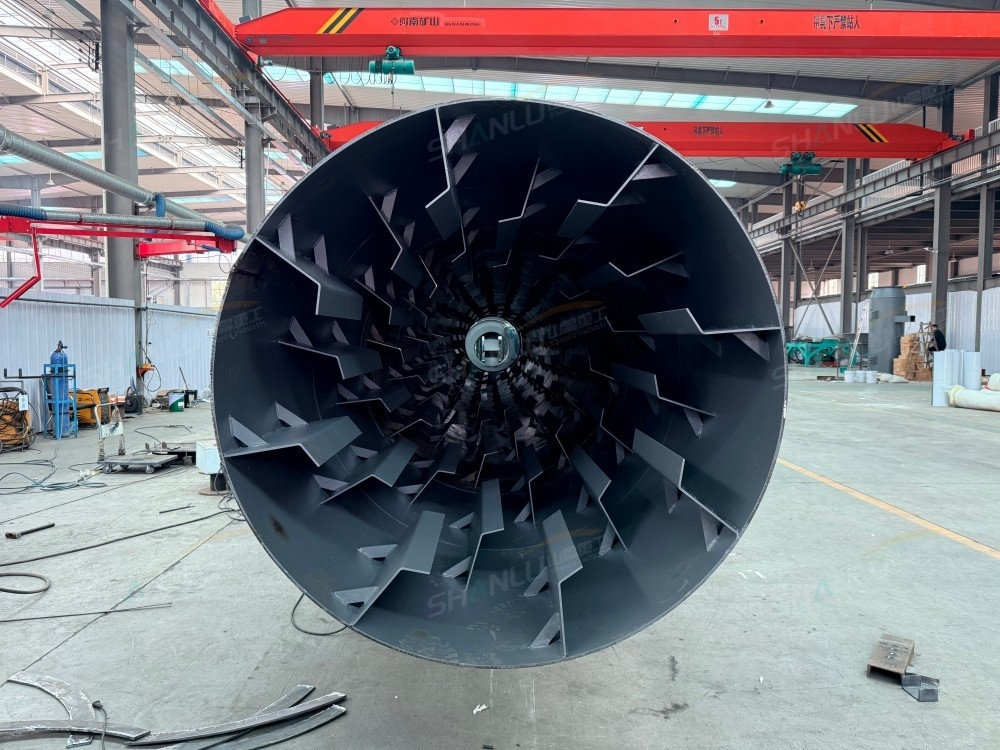
Improper induced-draft negative pressure causes wet steam to "return dampness." When the moisture-exhaust air volume and the negative pressure inside the drum keep fluctuating, some high-humidity steam cannot be discharged from the drum in time and contacts the material again, causing discharge moisture to swing and completely depart from the preset control range. Check whether the induced-draft fan frequency is stable; when the negative pressure gauge reading fluctuates greatly, inspect the ducts for air leakage or blockage. In addition, when coarse particles and fine powder in quartz sand have the same residence time in the drum, coarse sand remains under-dried while fine powder is over-dried, which likewise intensifies moisture fluctuation. At the feed end, appropriately increase the density of lifters so fine powder passes through faster and coarse particles get a longer residence time.
Unstable discharge moisture is rarely caused by a single fault point. Systematic troubleshooting in the order of "first check feed stability, then the thermal system, and finally induced-draft negative pressure" is more effective than repeatedly adjusting one parameter. If you encounter problems during equipment operation, you are welcome to contact the Shanlu Heavy Industry technical team: Manager Zhang 13583776655 (same on WeChat).
label:
Next
related news


E-mail:
Hotline:
cell phone:
Copyright © 2012-2026 Shandong Shanlu Heavy Industry Technology Co., LTD All rights reserved 备案号:鲁ICP备2020040039号
