 简体中文
 English


What screen hole size should a trommel screen use to ensure screening accuracy?
release time:
2026-10-30
Trommel screens are responsible for controlling particle size in quartz sand pre-classification, but many customers report that the undersize product often contains oversized coarse particles, or that fine powder that sh
In quartz sand pre-classification, the trommel screen is responsible for controlling particle size, but many customers report that the undersize product is often mixed with oversized coarse particles, or that the fine powder that should be screened out is not cleaned thoroughly, and the screening accuracy clearly fails to meet requirements. The problem usually lies in the coordination of three aspects: screen aperture size, drum rotation speed, and feeding uniformity.
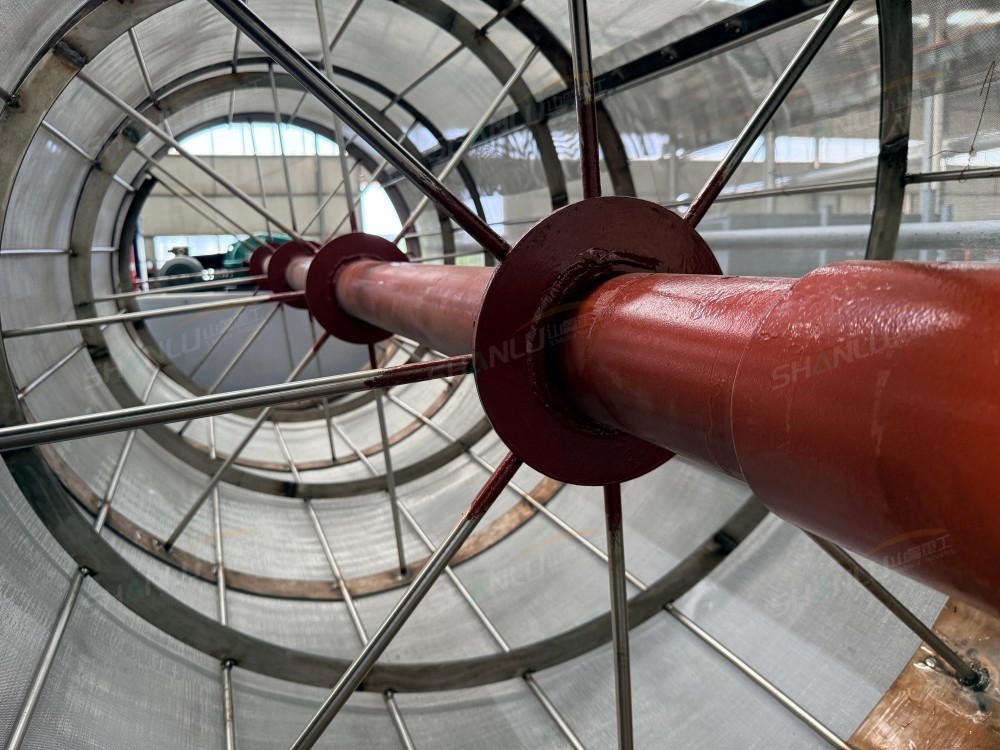
The mismatch between screen aperture size and feed particle size is the primary cause of substandard accuracy. When the aperture is too large, oversized coarse particles pass directly through the screen holes and mix into the product; when the aperture is too small, the fine powder that should pass through cannot do so, resulting in a low fine powder content in the undersize material. The appropriate aperture should be selected according to the finished product particle size requirements, and the actual screen aperture size should be periodically spot-checked with calipers. After the screen plate wears, the apertures deform and enlarge, which likewise causes screening accuracy to decline; severely worn screen plates need to be replaced promptly. When installing a new screen plate, pay attention to keeping the aperture direction consistent; installing it reversed will also affect screening performance.
Improper drum rotation speed means the material does not stay on the screen surface long enough. When the speed is too high, the material tumbles and advances rapidly inside the drum, and fine particles do not have time to contact the screen apertures before being carried by coarse particles out of the discharge end; when the speed is too low, the material layer piles up too thick, making it difficult for the fine powder at the bottom to pass through. Normal speed is generally controlled at 12-18 r/min; for materials with high fine powder content, use a higher value, and for materials dominated by coarse particles, use a lower value. Speed adjustment is done through a frequency converter, adjusting 2 r/min each time, and observing the screening effect for 2 hours before deciding the next step.
Uneven feeding will also lower screening accuracy. When material falls concentrated on one side of the screen surface, the material layer in that area is too thick and the fine powder does not pass through sufficiently; on the other side the material layer is too thin, and coarse particles easily bounce directly through the screen apertures. A distribution plate should be installed at the trommel screen feed inlet so that the material is evenly distributed along the drum axis. When the feed rate fluctuates greatly, a buffer bin can be added upstream to stabilize feeding.
During daily inspections, sample and test the undersize particle size once per shift. When an increase in oversized particles is found, troubleshoot in the order of "first check screen aperture size, then adjust drum rotation speed, and finally check feed distribution." Shanlu Heavy Industry has served the quartz sand screening equipment field for many years and can provide trommel screen aperture selection and rotation speed adjustment recommendations based on material characteristics. If you encounter problems during equipment operation, you are welcome to contact the Shanlu Heavy Industry technical team: Manager Zhang 13583776655 (same on WeChat).
label:
Next
related news


E-mail:
Hotline:
cell phone:
Copyright © 2012-2026 Shandong Shanlu Heavy Industry Technology Co., LTD All rights reserved 备案号:鲁ICP备2020040039号
