 简体中文
简体中文 English

Why can't the moisture content of dewatering screen discharge always be reduced?
release time:
2026-10-16
The vibrating dewatering screen is responsible for reducing moisture in the quartz sand wet production line, but many customers find that water runs off severely on the screen surface—water does not drain through the scr
The vibrating dewatering screen is responsible for reducing moisture in quartz sand wet production lines, but many customers find that water runs off the screen surface severely—instead of draining through the screen holes, the water flows out from the discharge end along with the sand, keeping the finished product moisture content persistently high and sharply increasing the pressure on subsequent drying or packaging processes. The problem usually lies in the coordination of three factors: feed concentration, screen surface inclination angle, and screen mesh selection.
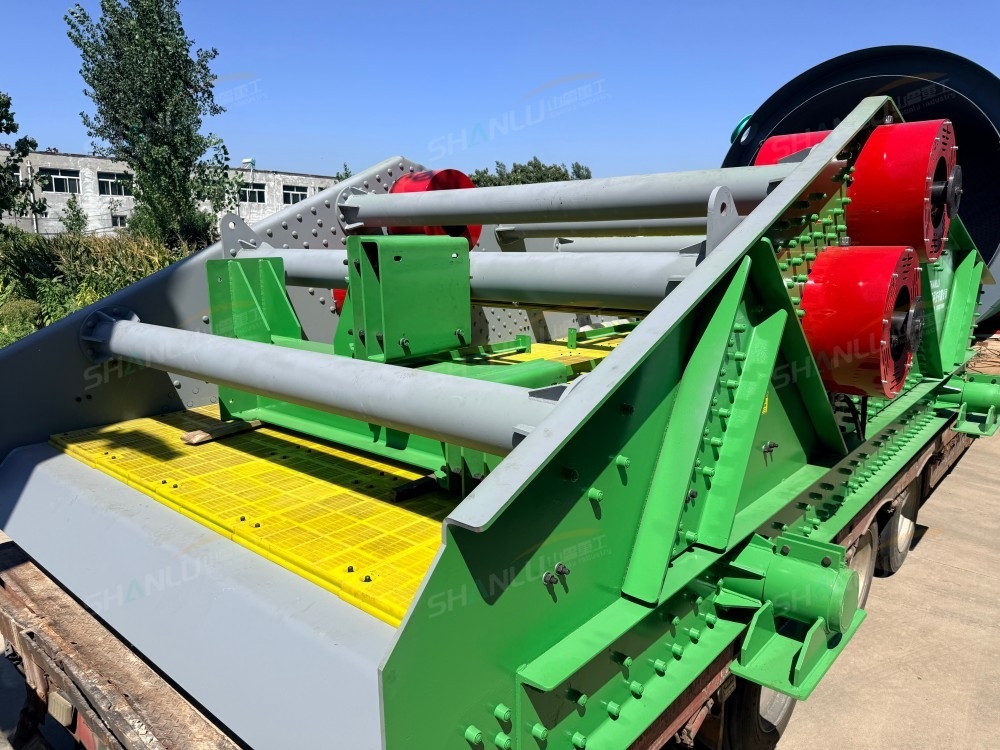
Feed concentration being too low is the primary cause of water runoff. When the slurry concentration entering the dewatering screen is below 40%, the water volume far exceeds the sand volume, and the screen surface cannot filter out all the water in time. The excess water then overflows from the discharge end carrying fine sand with it. The solution is to check the working status of the upstream thickener or cyclone and stabilize the slurry concentration entering the screen between 40%-55%. If there is no concentration equipment upstream, a small thickener or settling tank can be added before the dewatering screen to reduce water volume before entering the screen.
Improper screen surface inclination angle can also cause water runoff. If the angle is too small, the material stays on the screen surface too long. Although water can drain through, the processing capacity decreases, the material layer accumulates thicker and thicker, and the moisture in the bottom layer is carried away before it can be discharged. If the angle is too large, the material slides down too quickly, and water is discharged along with the sand before it can pass through the screen. It is recommended to control the screen surface inclination angle between 7-10°. For coarse sand processing, use a larger value; for fine sand, use a smaller value. When adjusting, change by 1° each time and observe the discharge moisture content change over 2 hours to gradually find the optimal angle.
Incorrect screen mesh selection can also trigger water runoff. If the mesh count is too high (e.g., above 100 mesh), the screen holes are too fine, the water drainage channels are insufficient, and a water film easily forms on the screen surface, causing water to follow the sand. If the mesh count is too low (e.g., 20 mesh), a large amount of fine sand is lost, the solid content in the underflow water is high, and water is also more likely to run off from the discharge end. For quartz sand dewatering, 40-60 mesh polyurethane screen mesh is recommended, balancing water permeability and sand retention capacity. If the material contains a high proportion of -200 mesh fine powder, a water baffle can be added on the screen surface to extend the slurry retention time on the screen surface.
During daily inspections, observe the discharge moisture content once per shift. If it is significantly high, troubleshoot one by one in the order of "first check feed concentration, then adjust screen surface inclination angle, and finally check screen mesh count." Shanlu Heavy Industry has served the quartz sand dewatering and screening field for many years and can provide screen mesh selection and angle adjustment recommendations based on material particle size and capacity requirements. If you encounter problems during equipment operation, you can contact the Shanlu Heavy Industry technical team for communication: Manager Zhang 13583776655 (same on WeChat).
label:
Next
related news


E-mail:
Hotline:
cell phone:
Copyright © 2012-2026 Shandong Shanlu Heavy Industry Technology Co., LTD All rights reserved 备案号:鲁ICP备2020040039号
