Is there a relationship between dewatering screen support beam wear and screen mesh breakage?


release time:

2026-09-24

Vibrating dewatering screens are responsible for reducing moisture in quartz sand wet production lines, but frequent screen mesh damage is a headache for many customers. Some screen meshes develop cracks within less than

The vibrating dewatering screen is responsible for reducing moisture in quartz sand wet production lines, but frequent screen mesh breakage is a headache for many customers. Some screens develop cracks in less than a week after installation, material leaks through the cracks, and dewatering performance drops significantly. The problem usually isn't the screen quality itself, but the screen tension and feeding method.
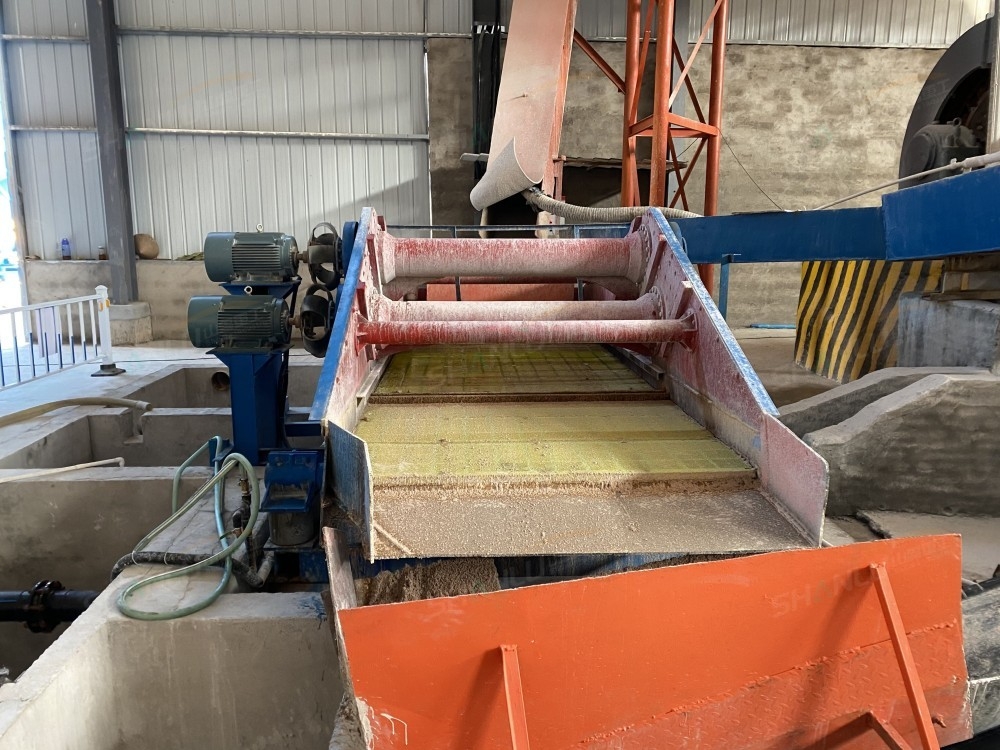
振动脱水筛 (22).jpg

Insufficient screen tension is the primary cause of early screen breakage. If a polyurethane screen is installed with insufficient tension, it will vibrate up and down during operation, repeatedly striking the support beams, and cracks will form at the fixing bolt holes in a short time. The correct approach is to use a tensioning tool to stretch the screen until it doesn't sink when pressed by hand, then tighten the clamp bolts. After each screen replacement, run it without load for 15 minutes first, observe whether the screen surface is loose, and re-tension immediately if any slack is found.

Eccentric feeding or excessive material layer thickness will also accelerate screen damage. If material continuously falls on one side of the screen surface for a long time, the screen in that area bears far greater impact than other parts, and localized damage will soon occur. A distribution plate should be installed at the dewatering screen feed inlet to spread material evenly across the entire screen surface. The material layer thickness is recommended to be controlled at 30-50mm; if too thick, the bottom material is difficult to pass through the screen, and it also increases the load on the screen surface. When feed volume needs to be increased, prioritize widening the screen surface or reducing the feed speed, rather than piling up the material layer to boost output.

Worn support beams or aged rubber pads can also cause screen breakage. After the support beam surface wears, sharp edges appear, and the screen repeatedly rubs against these sharp edges during vibration, quickly getting cut. Check the support beam wear once a quarter; when wear exceeds 2mm, weld and grind it smooth. When the rubber buffer pads between the support beams and the screen age and harden, they lose their cushioning effect, which also accelerates screen damage. It is recommended to replace the rubber pads every six months.

During daily inspections, check the screen surface for damage or slack once per shift, and replace it promptly when cracks are found—don't wait until large-scale tearing occurs to shut down. For equipment operation-related issues, you are welcome to call Shanlu Heavy Industry: Manager Zhang 13583776655 (same on WeChat).

label:


If you would like to learn more detailed information about Shandong Shanlu Heavy Industry Technology Co., Ltd., please feel free to contact us. We look forward to working with you!


Copyright © 2012-2026 Shandong Shanlu Heavy Industry Technology Co., LTD All rights reserved   备案号:鲁ICP备2020040039号

Leave your information

If you have any suggestions or questions, please contact us!

We use cookie to improve your online experience. By continuing to browse this website, you agree to our use of cookie.

Cookies

Please read our Terms and Conditions and this Policy before accessing or using our Services. If you cannot agree with this Policy or the Terms and Conditions, please do not access or use our Services. If you are located in a jurisdiction outside the European Economic Area, by using our Services, you accept the Terms and Conditions and accept our privacy practices described in this Policy.
We may modify this Policy at any time, without prior notice, and changes may apply to any Personal Information we already hold about you, as well as any new Personal Information collected after the Policy is modified. If we make changes, we will notify you by revising the date at the top of this Policy. We will provide you with advanced notice if we make any material changes to how we collect, use or disclose your Personal Information that impact your rights under this Policy. If you are located in a jurisdiction other than the European Economic Area, the United Kingdom or Switzerland (collectively “European Countries”), your continued access or use of our Services after receiving the notice of changes, constitutes your acknowledgement that you accept the updated Policy. In addition, we may provide you with real time disclosures or additional information about the Personal Information handling practices of specific parts of our Services. Such notices may supplement this Policy or provide you with additional choices about how we process your Personal Information.


Cookies

Cookies are small text files stored on your device when you access most Websites on the internet or open certain emails. Among other things, Cookies allow a Website to recognize your device and remember if you've been to the Website before. Examples of information collected by Cookies include your browser type and the address of the Website from which you arrived at our Website as well as IP address and clickstream behavior (that is the pages you view and the links you click).We use the term cookie to refer to Cookies and technologies that perform a similar function to Cookies (e.g., tags, pixels, web beacons, etc.). Cookies can be read by the originating Website on each subsequent visit and by any other Website that recognizes the cookie. The Website uses Cookies in order to make the Website easier to use, to support a better user experience, including the provision of information and functionality to you, as well as to provide us with information about how the Website is used so that we can make sure it is as up to date, relevant, and error free as we can. Cookies on the Website We use Cookies to personalize your experience when you visit the Site, uniquely identify your computer for security purposes, and enable us and our third-party service providers to serve ads on our behalf across the internet.

We classify Cookies in the following categories:
 ●  Strictly Necessary Cookies
 ●  Performance Cookies
 ●  Functional Cookies
 ●  Targeting Cookies


Cookie List
A cookie is a small piece of data (text file) that a website – when visited by a user – asks your browser to store on your device in order to remember information about you, such as your language preference or login information. Those cookies are set by us and called first-party cookies. We also use third-party cookies – which are cookies from a domain different than the domain of the website you are visiting – for our advertising and marketing efforts. More specifically, we use cookies and other tracking technologies for the following purposes:

Strictly Necessary Cookies
These cookies are necessary for the website to function and cannot be switched off in our systems. They are usually only set in response to actions made by you which amount to a request for services, such as setting your privacy preferences, logging in or filling in forms. You can set your browser to block or alert you about these cookies, but some parts of the site will not then work. These cookies do not store any personally identifiable information.

Functional Cookies
These cookies enable the website to provide enhanced functionality and personalisation. They may be set by us or by third party providers whose services we have added to our pages. If you do not allow these cookies then some or all of these services may not function properly.

Performance Cookies
These cookies allow us to count visits and traffic sources so we can measure and improve the performance of our site. They help us to know which pages are the most and least popular and see how visitors move around the site. All information these cookies collect is aggregated and therefore anonymous. If you do not allow these cookies we will not know when you have visited our site, and will not be able to monitor its performance.

Targeting Cookies
These cookies may be set through our site by our advertising partners. They may be used by those companies to build a profile of your interests and show you relevant adverts on other sites. They do not store directly personal information, but are based on uniquely identifying your browser and internet device. If you do not allow these cookies, you will experience less targeted advertising.

How To Turn Off Cookies
You can choose to restrict or block Cookies through your browser settings at any time. Please note that certain Cookies may be set as soon as you visit the Website, but you can remove them using your browser settings. However, please be aware that restricting or blocking Cookies set on the Website may impact the functionality or performance of the Website or prevent you from using certain services provided through the Website. It will also affect our ability to update the Website to cater for user preferences and improve performance. Cookies within Mobile Applications

We only use Strictly Necessary Cookies on our mobile applications. These Cookies are critical to the functionality of our applications, so if you block or delete these Cookies you may not be able to use the application. These Cookies are not shared with any other application on your mobile device. We never use the Cookies from the mobile application to store personal information about you.

If you have questions or concerns regarding any information in this Privacy Policy, please contact us by email at . You can also contact us via our customer service at our Site.