 简体中文
 English


Why can a single grain of quartz sand go from selling at 220 yuan per ton to being priced by the gram?
release time:
2026-11-28
The price of a grain of sand can jump from a few hundred yuan per ton to being sold by the gram. The gap lies not in the ore source itself, but in how much of the purification process from ore to material has been comple
The price of a single grain of sand can jump from a few hundred yuan per ton to being sold by the gram — the difference lies not in the ore source itself, but in how much of the purification process between ore and material has been completed. What is most worth watching in the quartz sand industry right now is precisely the starkly different survival logic on either side of this dividing line.
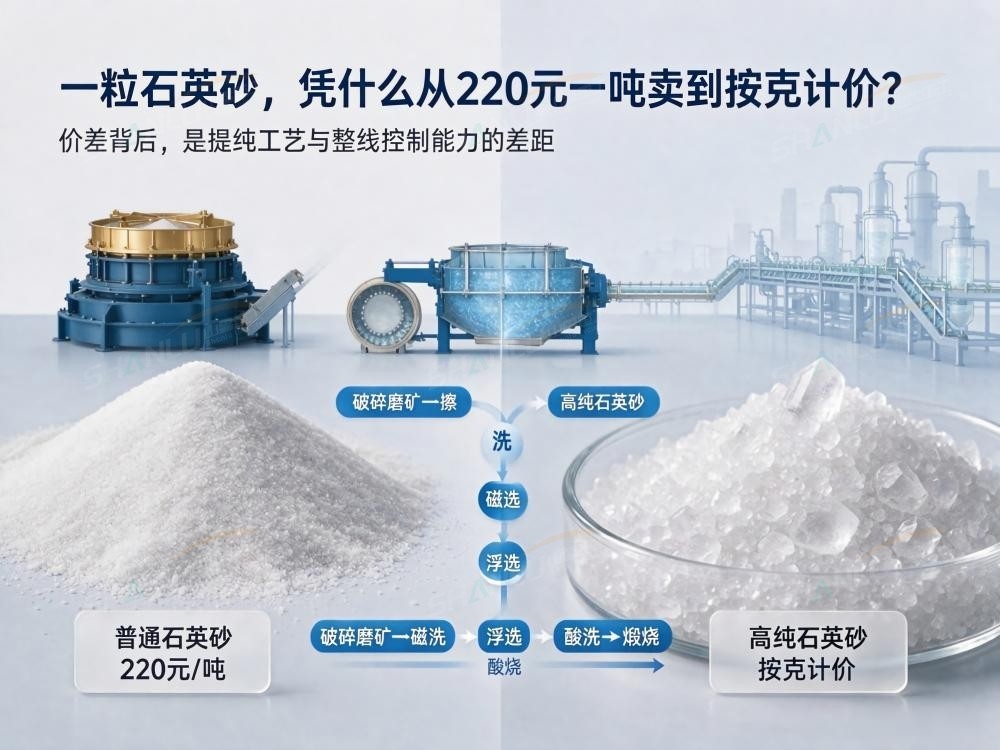
Ordinary quartz sand (SiO₂ 90%-99%) mainstream quotes have long hovered around 220 yuan/ton, refined sand at only 350 yuan/ton, and the industry's average gross margin has been squeezed to 5%-8%, with many production lines operating at less than 60% capacity. At the other end, imported spot prices for high-purity quartz sand above 4N8 purity remain firm at over 50,000 yuan/ton, with semiconductor-grade material counted in tens of thousands of US dollars per ton. It is the same "sand," yet prices differ by two orders of magnitude — the reason lies in the precision of impurity control: ordinary sand typically has an iron content of 100-200 ppm, while high-end low-iron sand requires iron to be pressed below 5 ppm; photovoltaic crucible inner-layer sand has even stricter requirements for alkali metals and inclusions.
Purifying ore to that level of precision does not rely on some single "magic device," but on a process chain in which each stage meshes with the next. Crushing and grinding first liberate quartz from gangue minerals; scrubbing strips away surface iron films and clay; magnetic separation captures strongly and weakly magnetic iron impurities — wet high-gradient magnetic separation plays a key role in removing fine-grained weakly magnetic impurities, with the optimal magnetic induction typically concentrated in the 1.0-2.0T range. But magnetic separation results are not determined by field strength alone: if any parameter — feed particle size, slurry concentration, or flow rate — drifts, mechanical entrainment will mix already-separated impurities back into the concentrate. After magnetic separation, flotation removes non-magnetic silicate gangue such as feldspar and mica; acid washing further dissolves trace iron and aluminum in crystal lattices and fissures; finally, calcination or chlorination completes deep purification. The performance of each individual unit matters, of course, but what truly determines the ceiling of final purity is the parameter matching and impurity-flow control between upstream and downstream stages.
On the equipment side, the industry is evolving toward "whole-line stability." A recently reviewed large-scale quartz sand classification magnetic separation and deep purification technology has built a cascade impurity-removal system of "drum-type weak magnetic separation — vertical ring high-gradient magnetic separation — fine-particle slurry high-gradient magnetic separation." Paired with dynamic fluidized-bed continuous acid washing, the Fe₂O₃ content of the concentrate can be controlled below 100 ppm, while upgrading traditional intermittent acid leaching to a continuous acid-washing process, reducing overall energy consumption by more than 80%. This means that large-scale, stable production of high-purity sand is shifting from "stacking performance with individual machines" to "controlling fluctuations with the system."
For quartz sand processing enterprises, judging the value of a production line should not depend only on how many pieces of equipment it has installed or how high the individual unit parameters are rated, but more on whether the ingress and egress of impurities at every stage along the whole line are controllable and whether parameter fluctuations converge. Shanlu Heavy Industry has long tracked process evolution in the field of quartz sand purification equipment and can provide complete equipment configuration concepts — from crushing and grinding, scrubbing and magnetic separation to classification and dewatering, acid washing and calcination — tailored to raw ore characteristics and target purity. If you encounter specific issues in production line planning or equipment matching, you are welcome to contact the Shanlu Heavy Industry technical team: Manager Zhang 13583776655 (same on WeChat).
label:
related news


E-mail:
Hotline:
cell phone:
Copyright © 2012-2026 Shandong Shanlu Heavy Industry Technology Co., LTD All rights reserved 备案号:鲁ICP备2020040039号
